
Technical ceramics are selected for demanding environments, but manufacturing them can be challenging. Should an engineer machine a part from fired ceramic stock, shape it before sintering, or use ceramic additive manufacturing? Drawing on 3DCeram Sinto’s experience in ceramic stereolithography and industrial process development, this guide compares CNC machining with ceramic 3D printing. The best choice depends on geometry, material requirements, precision, production volume and the complete manufacturing route—not simply on machine speed.
CNC machining removes material using programmed cutting tools. For technical ceramics, the route may involve machining a pre-sintered (green or partially fired) blank, hard machining a sintered component, or a combination of both. Tool access, fixture design, abrasive wear and the risk of chipping or cracking can influence feasibility and cost.
Ceramic additive manufacturing instead shapes a part layer by layer from a digital design. In ceramic stereolithography (SLA) or digital light processing (DLP), light cures a ceramic-loaded slurry. 3DCeram Sinto specializes in ceramic SLA and develops both printing equipment and ceramic feedstocks. The printed green part then requires cleaning, debinding and sintering: printing alone does not produce a finished technical-ceramic component.
Neither process is universally easier. CNC concentrates much of its complexity in tooling, access and cutting strategy, while ceramic 3D printing moves significant complexity to part orientation, support design, slurry behavior and thermal post-processing.
| Decision factor | CNC machining of ceramics | Ceramic SLA / DLP printing |
|---|---|---|
| Geometry | Strong for accessible features; enclosed channels and deep recesses can be difficult. | Enables intricate internal channels, lattice structures and complex integrated shapes, subject to cleaning and firing constraints. |
| Precision & finish | Can achieve demanding finishes on accessible surfaces with appropriate equipment and process control. | Final dimensions depend on shrinkage and firing; critical surfaces may require finishing. |
| Tooling & setup | May require several fixtures, cutting tools and setups. | Avoids geometry-specific molds; requires build preparation and post-processing equipment. |
| Production economics | Often attractive for simpler designs, established routings or particular batch sizes. | Can favor complex, customized or low-volume components; economics depend on throughput and yield. |
Alumina, zirconia and other advanced ceramics combine valuable functional properties with demanding processing behavior. High hardness after sintering makes material removal difficult, while brittleness raises the possibility of edge chipping, microcracks or part rejection. Complex shapes may need multiple setups, specialist tooling or substantial material removal.
Machining before full sintering can ease cutting, but the part still changes dimension during firing. Hard machining after sintering can deliver precise interfaces, although it adds time and equipment demands. Manufacturers therefore need to assess the full sequence—not just the CNC cycle time.
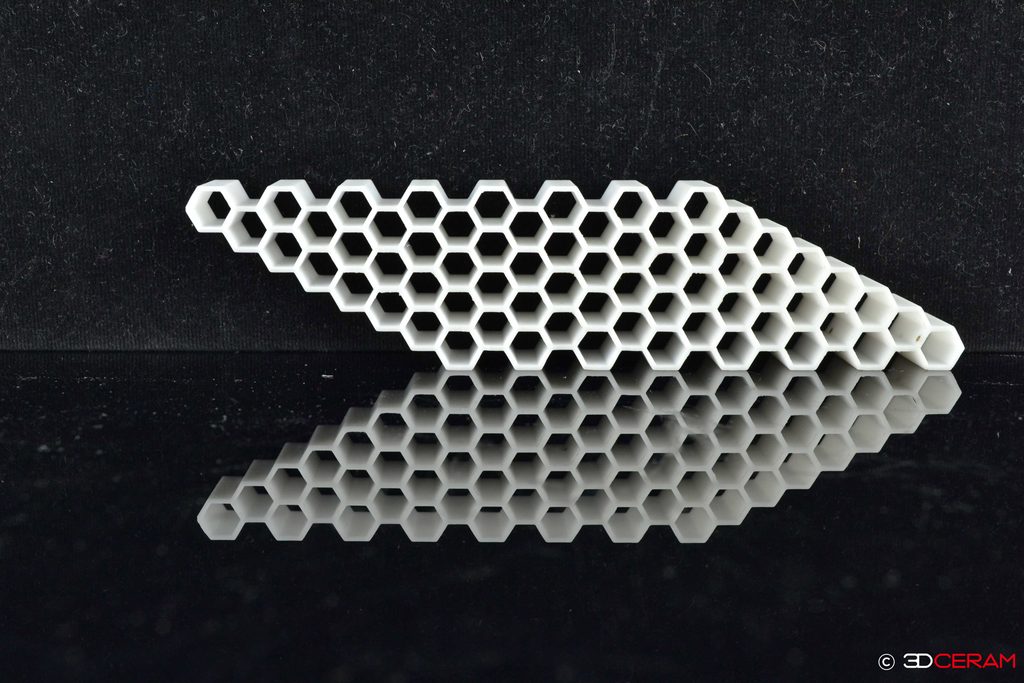
The strongest argument for additive manufacturing is geometric freedom. Internal flow passages, lightweight lattices and consolidated multi-feature components may be difficult, costly or impractical to produce by subtractive methods. Digital production also reduces dependence on dedicated forming molds. 3DCeram’s SLA range supports this approach from development to industrial production: the C101 EASY FAB (100x100x150 mm) for smaller builds and process development, the C1000 FLEXMATIC (320x320x200 mm) for larger-scale production, and the C3601 ULTIMATE (600x600x300 mm) for large ceramic components and mass production.
However, additive manufacturing has its own design rules. Trapped slurry must be removable, fragile green features need adequate support, and debinding and sintering must suit the geometry. 3DCeram’s process expertise covers these critical steps as well as printing. A representative fired test part is essential before committing to production.
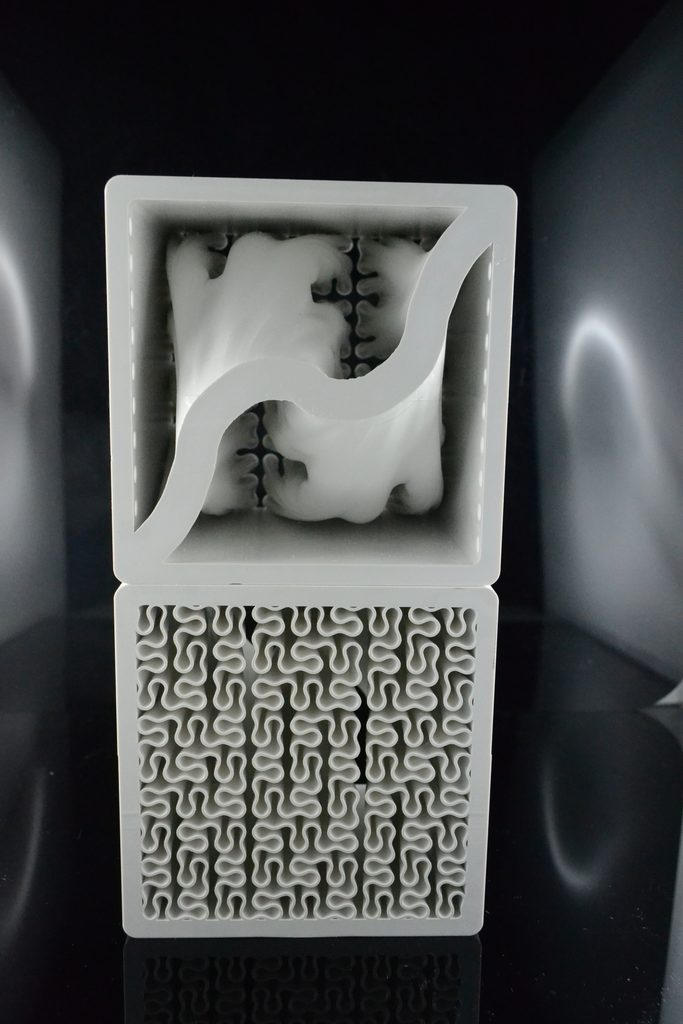
Comparisons should be based on the finished, inspected ceramic part. CNC performance depends on tool access, machining stage, material and equipment. Ceramic SLA performance depends on exposure, orientation, cleaning, dimensional compensation and the firing cycle. For either route, specify the tolerances and roughness only where function requires them.
Cost per accepted part is more informative than machine time or quoted printing time. Include material use, tooling, operator time, cleaning, debinding, sintering, inspection, finishing and rejects. For straightforward, accessible geometries, CNC may remain the practical choice. As geometric complexity increases or tooling becomes burdensome, additive manufacturing can become more compelling.
| Part requirement | Route worth evaluating | What to validate |
|---|---|---|
| Simple plate, slot or accessible bore | CNC machining | Stock availability, fixture stability, achievable tolerance and total unit cost. |
| Intricate channels or lattice | Ceramic SLA / DLP | Slurry evacuation, feature integrity, firing deformation and internal inspection. |
| Complex body with tight mating faces | Additive + selective CNC finishing | Machining allowance, datum strategy and final dimensions after firing. |
| Repeated series production | Compare both using a pilot batch | Throughput, process stability, yield and cost per conforming part. |
Yes. A hybrid production strategy can print near-net-shape ceramic geometry and then machine selected datums, sealing faces or bores. This combines additive design freedom with controlled finishing where it matters. The additional operations are justified only when they improve the performance or economics of the complete route.
3DCeram’s M.A.T. (Multi Additive Technology) platform illustrates the value of combining additive operations and CNC machining in one manufacturing approach. The specific process sequence and material compatibility must still be evaluated for each application; it should not be assumed that every fired ceramic feature can be machined in the same way.
3DCeram applies ceramic additive manufacturing to demanding fields such as aerospace, semiconductor equipment, defense and energy. Semiconductor parts may require chemical stability, precise interfaces and complex functional geometries; aerospace and energy designs may benefit from lightweight structures or optimized flow paths. In every case, material properties, inspection requirements and production repeatability must be demonstrated on the final fired part.
Before choosing, answer five questions: Can a cutting tool reach every essential feature? Which material and fired properties are required? What tolerances and surface finishes are functionally critical? How many conforming parts are needed? And what cleaning, firing, finishing and qualification steps does each route involve?
CNC machining remains valuable for accessible, precision-critical ceramic features. Ceramic additive manufacturing expands what can be designed and can reduce the need for dedicated forming tools. Hybrid manufacturing may offer the best compromise when complex shapes need accurately finished interfaces. Compare both routes on validated final-part performance, repeatability and cost, not on headline process speed alone.
Evaluating a technical-ceramic component? Explore 3DCeram’s ceramic SLA solutions from the C101 EASY FAB to the C1000 FLEXMATIC and C3601 ULTIMATE alongside its M.A.T. hybrid platform, or contact the 3DCeram Sinto team to discuss material selection, part feasibility and the right manufacturing workflow.