How to evaluate ceramic slurry, printer capability and production fit for industrial parts
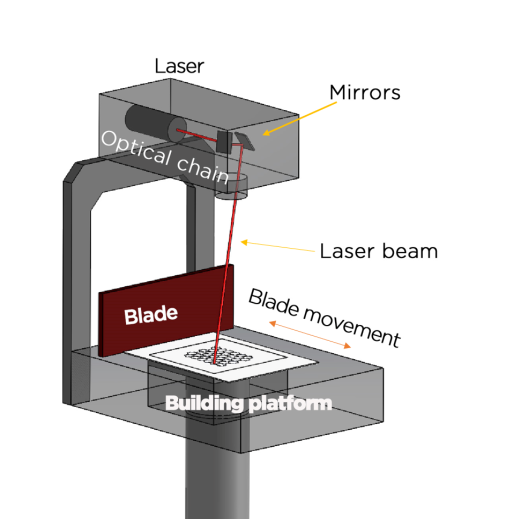
Stereolithography (SLA) uses a laser to cure a light-sensitive material layer by layer. In ceramic 3D printing, that material is a slurry of ceramic powder and photosensitive binder. An SLA ceramic 3D printer forms a fragile “green” part; cleaning, binder removal and sintering turn it into the finished ceramic component. Choosing an SLA ceramic 3D printer means matching the machine, slurry and firing process to the part’s shape and intended use. This guide explains what to check when comparing systems and compatible materials.
“SLA ceramic resin” is a common search phrase, but industrial ceramic feedstock is usually called a slurry or suspension. It combines ceramic powder with a photosensitive binder that lets a UV laser cure the slurry layer by layer. These formulations are not interchangeable with standard polymer resins, and a printer’s compatibility must be confirmed for the specific slurry, exposure settings and cleaning process. 3DCeram’s 3DMIX ceramic slurries are formulated for CERAMAKER systems, so the material and machine should be reviewed together
After printing, operators remove uncured slurry and clean the green part either manually or with 3DCeram’s AUTO CERAKLEANER, an automated cleaning machine for 3D-printed ceramic parts. They then debind it to remove the organic binder. Sintering bonds the ceramic particles to form the finished part. The green body is fragile, and dimensions change during firing. Validate the firing cycle and dimensions with the chosen ceramic and part shape. The ceramic formulation and firing cycle set the final properties.
Define service conditions and acceptance requirements before shortlisting machines. Specify operating temperature, chemistry, vacuum or plasma exposure, electrical role, mechanical loads, wear and thermal cycling. Then set part size, smallest features, wall thickness, tolerance, surface finish, cleanliness and annual quantity. A wafer-handling fixture, a gas-flow component and a high-temperature insulator may all use technical ceramics, but they need different tests.
Select a formulation for the properties required in the final, sintered material. Alumina, zirconia, silicon nitride, aluminum nitride, silica-based materials and other ceramics offer different trade-offs. Request data for the exact formulation and firing cycle, then confirm that it can be printed on the target machine. Do not infer service temperature from a cured-slurry datasheet.
3DCeram also offers material solutions designed for open systems. CERA-BASE is a photopolymer binder system that enables users to develop their own ceramic suspensions using the ceramic powders of their choice. Cera XXX, on the other hand, is a range of ready-to-print ceramic slurries, available notably in alumina and zirconia and compatible with different photopolymerization wavelengths, providing greater flexibility across open platforms.
The geometry must fit the thermal route as well as the build platform. Thin walls and uniform sections can help control differential shrinkage; trapped slurry or closed cavities complicate cleaning and binder removal. Plan drainage paths, accessible surfaces and furnace supports early. Validate dimensional compensation on representative coupons or parts rather than relying on a universal shrinkage factor.
A printer specification sheet helps shortlist equipment, but resolution alone cannot qualify a process. Compare each system against the real part, the planned workflow and the expected rate of accepted output.
| Decision area | What to confirm | Why it matters | Evidence to request |
|---|---|---|---|
| Part and volume | Platform, orientation, spacing and parts per build. | A nominal envelope does not show usable output or furnace capacity. | Trial a representative batch and record accepted parts per cycle. |
| Features and accuracy | Laser spot, layer range, minimum feature, repeatability and shrinkage data. | Print resolution alone cannot predict final tolerances. | Measure coupons and fired parts against the drawing. |
| Slurry and material | Compatible ceramic grades, formulation data, supply and handling needs. | Feedstock properties and machine settings are linked. | Confirm the formulation and process window with the supplier. |
| Thermal workflow | Cleaning, debinding, atmosphere, supports, inspection and finishing. | This workflow sets yield and cost per accepted part. | Run a pilot with batch records and dimensional checks. |
Ask suppliers to print representative geometry with the chosen material, then assess it after cleaning, debinding and sintering. Inspect fired dimensions, visible defects, repeatability across builds, finishing effort and batch yield. Include software and file preparation, material monitoring, operator training, maintenance, spare parts and process records in the review. If the site does not already have suitable cleaning and furnace capacity, include that equipment and its safety requirements in the installation plan.
Ceramic SLA is worth evaluating when a component needs fine detail, thin features, internal channels, customized geometry or consolidation of an assembly. It can remove mold lead time for prototypes and low-volume revisions, but the complete route still includes controlled firing and quality checks.
Compare SLA with DLP and LCD by exposure architecture, usable build area, slurry compatibility, feature limits and fired results. These light-based systems do not share one material window, and a projected pixel or screen pixel is not directly comparable with a laser spot. None of those resolution figures is a final-part tolerance. Ask vendors to demonstrate the same part and material.
Choose based on the features and production needs that matter, not a method label.
Compare in-house printing with specialist outsourcing using cost per accepted part, not machine purchase price or raw feedstock price alone. Include printer and furnace capacity, material losses, cleaning labor, debinding and sintering cycles, fixtures, metrology, finishing, energy, maintenance, training, spares and expected yield. Estimate capacity using realistic build utilization and all downstream steps.
Outsourcing can help validate designs, establish firing windows and measure demand before investing. In-house production may make sense when recurring work, lead-time needs or process control justify the equipment and staff. There is no reliable universal break-even volume without part geometry, utilization, yield and local costs. Use a pilot to measure these inputs before making the business case.
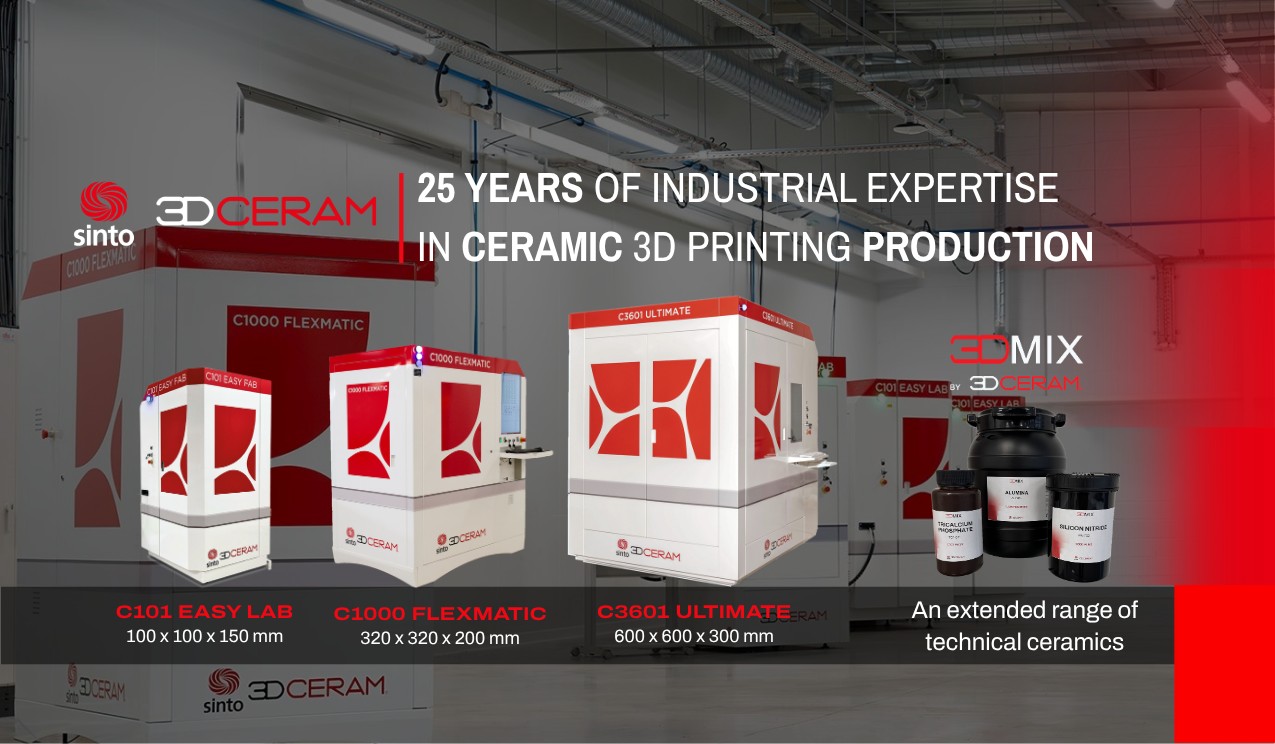
Within 3DCeram’s CERAMAKER range, the C101 EASY FAB provides a 100 x 100 x 150 mm build platform and is positioned for development and prototyping, with a scale-up route to larger printers. The C1000 FLEXMATIC has a 320 x 320 x 200 mm platform and is presented for larger parts and series production with semi-automated line integration. These are platform dimensions, not guaranteed part size or throughput; build layout and firing capacity must be checked against each design.
3DCeram formulates 3DMIX ceramic slurries for CERAMAKER printers and also describes on-demand formulations. For a machine shortlist, ask which material grades are available and what process data, training, cleaning and firing support accompany the selected configuration. Read the ceramic SLA process overview for a broader explanation of the technology.
Bring a representative CAD file, target material properties, operating environment, annual volume and critical tolerances to a technical discussion. Request a demonstration or sample-part evaluation, and agree in advance how the fired result will be measured. This gives engineering and procurement a shared basis for deciding whether to outsource a pilot or prepare an in-house workflow.